Sunday, October 19, 2014

Sainte Chapelle and Marché aux Fleurs et aux Oiseaux


The Sainte-Chapelle ("Holy Chapel"), located within the Palais de Justice complex on the Ile de la Cité in the center of Paris.  It was erected by Louis IX, king of France, to house the Crown of Thorns and a fragment of the True Cross, precious relics of the Passion. Louis had purchased these in 1239 from the Byzantine emperor Baldwin II, for the exorbitant sum of 135,000 livres (the chapel "only" cost 40,000 livres to build). Two years later, more relics were brought from Byzantium.

The original plan of the chapel dates from 1241. After breaking ground in January of 1246, the Sainte-Chapelle was rapidly constructed, and completed April 25, 1248.

The Upper Chapel

 
Upper chapel of Sainte-Chapelle  
 
Upper chapel of Sainte-Chapelle
© Christopher Callahan
 
 
The upper chapel was the part of the building reserved for the king, his close friends and family, as well as for displaying the religious relics.
The holy relics purchased by Saint Louis were kept in a large, richly decorated reliquary, placed at the summit of the open tribune, at the back of the apse. In addition to the Crown of Thorns and a piece of the True Cross, the Sainte-Chapelle's collection of relics included a number of other key pieces mentioned in both Testaments of the Bible.
   
  Lower chapel of Sainte-Chapelle
 
  Lower chapel of Sainte-Chapelle
© Jane Raley
 

The Lower Chapel

The lower chapel is dedicated to the Virgin Mary, whose statue stands freely next to the central pier of the portal. During the period of the monarchy, the lower chapel was reserved for palace staff.

 
Detail of stained glass window
 
Every picture tells a story: detail of roundel from stained glass lancet-window on south side of upper chapel
(ca. 1246-1248 A.D.).
© Art Images for
College Teaching


Stained Glass

Sainte-Chapelle is renowned for its richly hued stained glass windows. Two-thirds of the pieces are original works, representing the finest examples of 12th century craftsmanship. Reds and blues are the dominant colors, in contrast with the 15th century western rose window. In these panes the full biblical story of humanity is recounted, from the Creation to redemption through Christ; Genesis, Exodus, Numbers, Deuteronomy, Judges, Isaiah, the Tree of Jesse, Saint John the Baptist, Daniel, Ezekiel, Jeremiah, Tobias, Judith and Job, Esther, the Book of Kings, and the History of the Relics follow one to the next. Each window, divided into arches, reads from left to right and from top to bottom.
Following a period of disaffection for the Sainte-Chapelle in 1803, its stained-glass windows were stored in a two-meter space, in order to use the building as a repository for the state's archives. They were admirably restored in the 19th century, then carefully removed during World War II in anticipation of the German invasion of Paris. Following the war, every piece was meticulously replaced.


The chapel walls are essentially stained glass


The tile floor

Located inside the Palais de Justice complex - you can see the spire


Marché aux Fleurs et aux Oiseaux

Paris market: Marché aux Fleurs et aux Oiseaux  
Photograph: John Brunton
Operating for over two centuries, this is one of the last Parisian
markets dedicated to flowers and birds. Situated on the Île de la Cité in the middle of the Seine, this is a haven of peace between the crowds of tourists that flock to nearby Notre Dame cathedral and the Conciergerie. Unlike any other Parisian marché, the flower market is open every day of the week. By contrast, it is only on Sundays that the bird traders arrive, setting up cages with everything from doves and budgies to exotic parrots and macaws.


Notre-Dame de Paris - Our Lady of Paris

A view of Notre-Dame de Paris  


Notre-Dame de Paris ("Our Lady of Paris"), also known as Notre-Dame Cathedral or simply Notre-Dame, is a historic Catholic cathedral on the eastern half of the Île de la Cité in the fourth arrondissement of Paris. The cathedral is widely considered to be one of the finest examples of  French gothic architecture and among the largest and most well-known churches in the world. In the 1790s, Notre-Dame suffered desecration during the radical phase of the French Revolution when much of its religious imagery was damaged or destroyed.

Notre Dame dalla Senna.jpg
The southern facade of Notre-Dame de Paris
 -


My photo of the rose window
An image from the website.

Not the largest cathedral in the world, the Notre-Dame might be the most famous of all cathedrals. The Gothic masterpiece is located on the Île de la Cité, a small island in the heart of the city.

A Religious site

Notre Dame west facade
Notre Dame de Paris
The site of the Notre dame is the cradle of Paris and has always been the religious center of the city. The Celts had their sacred ground here, the Romans built a temple to worship Jupiter. A Christian basilica was built in the 6th century and the last religious structure before the Notre-Dame construction started was a Romanesque church.

Construction

Notre dame de Paris
Bishop Maurice de Sully started the construction in 1163. The Cathedral was to be built in the new Gothic style and had to reflect Paris's status as the capital of the Kingdom France. It was the first cathedral built on a monumental scale and became the prototype for future cathedrals in France, like the cathedrals of Amiens, Chartres or Rheims, just to name the most famous.

The Building

gargoyle
Gargoyle
It took until 1345 before the cathedral was completed, partly because the design was enlarged during construction. The result is an overwhelming building, 128m long (420 ft) with two 69 meter tall towers (226 ft). The spire, which reaches 90m (295 ft), was added in the 19th century by Viollet-le-Duc. The Notre-Dame Cathedral has several large rose windows, the northern 13th century window is the most impressive. The massive window has a diameter of 13.1 meter.

Gallery of Kings, Notre Dame de Paris
Gallery of Kings
The frontal west facade features three wide portals; above the portals is the Gallery of Kings - 28 statues of Judean Kings - and higher up are the famous gargoyles and grotesques. The spectacular eastern flying buttresses at the east side of the building are 15m wide.

Restoration

During the Revolution, many of the cathedral's sculptures, gargoyles and interior was removed or demolished. Even the gallery of Kings was severely damaged: the revolutionaries though the statues represented
Inside the Notre Dame de Paris Cathedral
Inside the cathedral
French Kings.

It wasn't until the 19th century before the Cathedral was fully restored thanks in part to the writer Victor Hugo, who with his book 'Notre-Dame de Paris', made the Parisians realise the cathedral was worth restoring. The 20 year long restoration was led by a local architect, Eugène Emmanuel Viollet-le-Duc. Viollet-le-Duc made drastic, controversial modifications to the building and even added a spire. The cathedral was restored again between 1991 and 2001, this time the historic architecture was carefully preserved.

A Walk Along the Seine


A walk along the Seine from the Museum to Notre Dame


The Louvre

The used-book sellers (bouquinistes) you see along the Seine around Notre-Dame are a Parisian fixture. They've been here since the mid-1500s, when shops and stalls lined most of the bridges in Paris. In 1557, these merchants were labeled as thieves for selling forbidden Protestant pamphlets during the Wars of Religion.
The term bouquinistes (boo-keen-eest) probably comes from the Dutch word boeckin, meaning "small book." First using wheelbarrows to transport and sell their goods, these hardy entrepreneurs eventually fastened trays to the parapets of the bridges with thin leather straps. After the Revolution, business boomed when entire libraries were liberated from nobles or clergymen and wound up for sale cheap on the banks of the Seine. In 1891, bouquinistes received permission to permanently attach their boxes to the quaysides. Today, the waiting list to become one of Paris' 250 bouquinistes is eight years.
Each bouquiniste is given four boxes, all of a specified size, and rent is paid only for the stone on which the boxes rest (less than €100 per year). The most coveted spots are awarded based on seniority. Maintenance costs, including the required vert wagon paint (the green color of old train cars), are paid by the bouquinistes. With little overhead, prices are usually cheaper than in most shops. Bouquinistes must be open at least four days a week. Wednesdays are best (when school is out), and warm, dry days are golden (notice that every item is wrapped in protective plastic). And yes, they do leave everything inside when they lock up at night; metal bars and padlocks keep things safe. (From Rick Steeves)


The Place Dauphine - lovely square (triangle) near Pont Neuf.


Place Dauphine on 1739 Turgot map of Paris - KyotoU.jpg
Place Dauphine in 1739


Lunch at a brasserie
In France, a brasserie  is a type of french restaurant with a relaxed setting, which serves single dishes and other meals. The word brasserie is also french for brewery.


    Musee d'Orsay

    A wonderful morning looking at the art of the impressionists at the Musee d'Orsay.
    http://www.musee-orsay.fr/en/home.html


    One of the world's most-visited museums, the Musee d'Orsay houses the largest collection of painting, sculpture, and decorative objects produced between 1848-1914, showcasing many of the most remarkable works of the early modern era.

    Giving visitors a detailed and breathtaking look at the birth of modern painting, sculpture, design, and even photography, the Musee d'Orsay's permanent collection spans from neoclassicism and romanticism to impressionism, expressionism, and art nouveau design.

    Highlights include important works by Ingres, Delacroix, Monet, Degas, Manet, Gaugin, Toulouse-Lautrec, and Van Gogh.


    http://upload.wikimedia.org/wikipedia/commons/8/80/MuseeOrsay_20070324.jpg
    The main hall of the museum.  It was a former train station.
    Magnificent clocks


    A marathon along the Seine near the museum.


    Opera Garnier


    Opera Garnier, or also known as Paris Opera, has a very long history. Founded originally by King Louis XIV, the opera is now widely known as Opera Garnier because it is hosted at Palais Garnier, a palace built according to a design by Charles Garnier in the 19th century.  The palace is also an important symbol of the 19th century baroque style in France. It was Napoleon III who ordered a competition to design a building which would serve as a part of great Parisian reconstruction project which was coined by Baron Haussmann. An architect named Charles Garnier won the competition and the rest is history.
    Opera Garnier, Paris
    The Palais Garnier
    The architecture of Palais Garnier is really grand from the outside. It is 172 meters long, 125 meters wide and 73,6 meters tall. Decorations are including sculpture, gargoyles, rose marble columns, friezes, and two large gilded statues. 

    Opera Garnier Paris
    Interior view

    Inseide Opera Garnier
    Inside Opera Garnier - I didn't get to visit but found this image.
    My photo.

    Saturday, October 18, 2014

    Galeries Lafayette


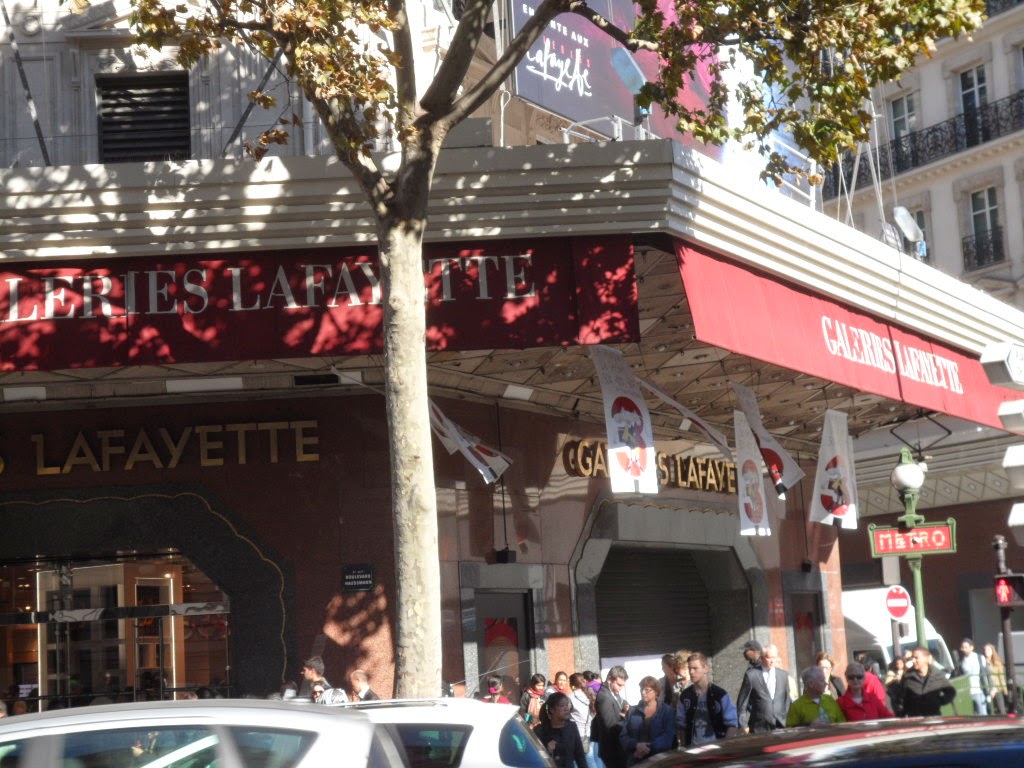
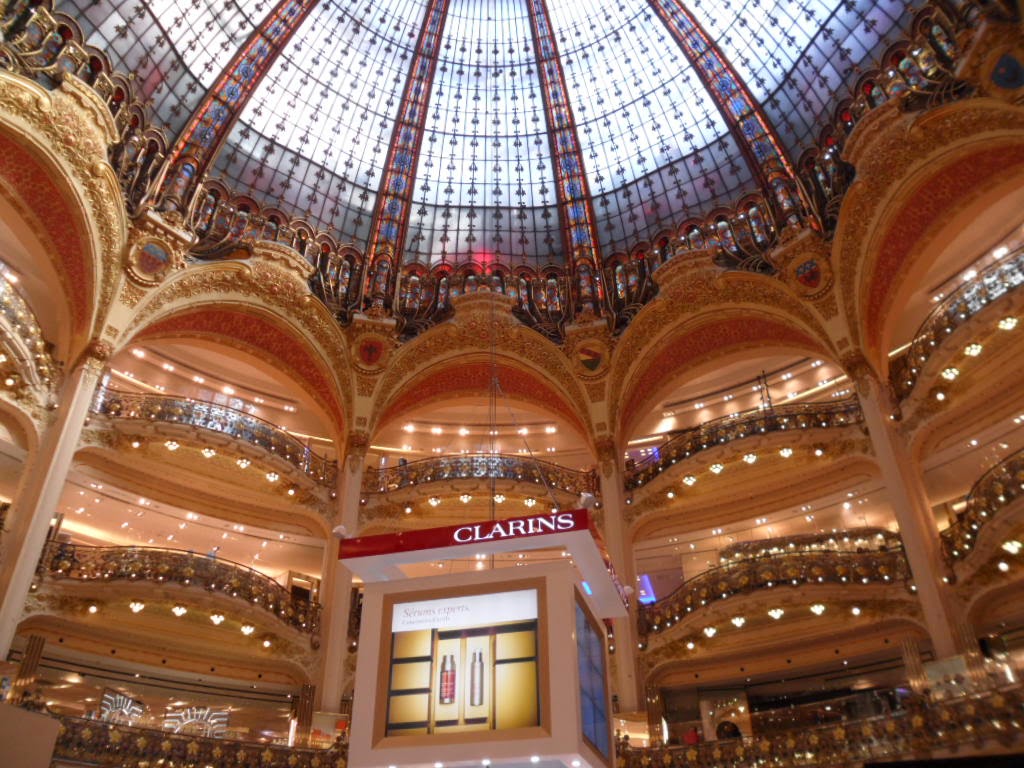
    The Galeries Lafayette  is an upmarket French department store located on Boulevard Haussmann in the 9th arrondissement of Paris near the Opera.


    http://upload.wikimedia.org/wikipedia/commons/6/6b/Galerie_Lafayette_Haussmann_Dome.jpg
    A view from Wikipedia

    A few of the Paris from the top of the building.


    Interior view